
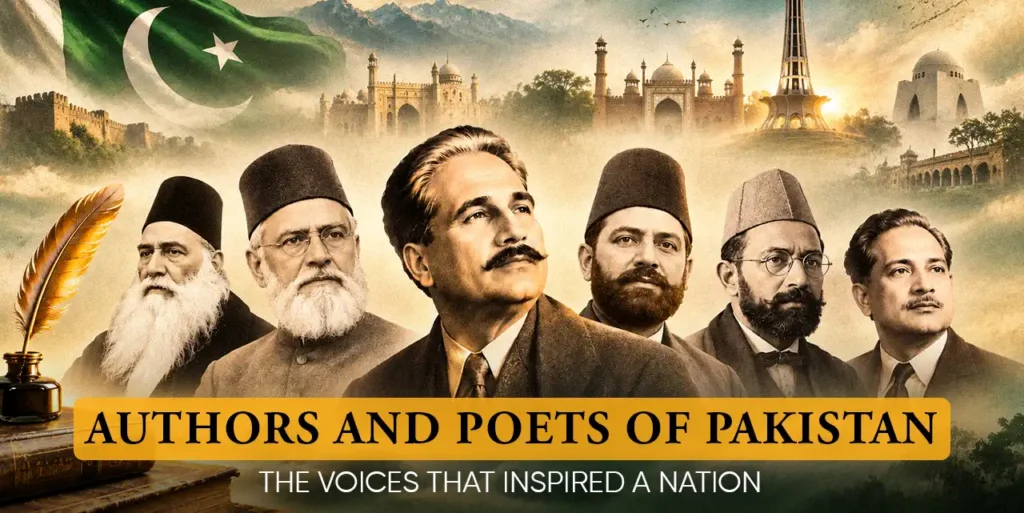
The creation of Pakistan in 1947 had a long history behind it. Before political leaders called for a separate homeland, Muslims in the Indian subcontinent were already discussing their role in society and their future. Writers, poets, journalists, and reformers shared their views on education, social problems, cultural values, and the rights of the Muslim. These discussions helped people understand the challenges in their communities.
Poets and authors played an important role in this discussion. The Poets of Pakistan, like Allama Iqbal, Altaf Hussain Hali, and Maulana Zafar Ali Khan, used their poems to talk about the concerns of Muslims. Their poetry and writings focused on education, history, culture, and the need for social change. Their poetry encouraged readers to think about Muslim history, the value of education, and the changes needed in society.
Key Takeaways
- Literature gave Muslims a way to express their views about their culture, society, and place in British India.
- Allama Iqbal’s philosophy and the 1930 Allahabad Address influenced discussions about Muslim political identity.
- Altaf Hussain Hali used poetry to encourage Muslim educational and social reform.
- Maulana Zafar Ali Khan and Muhammad Ali Jauhar used journalism to spread political awareness.
- Sir Syed Ahmad Khan transformed Muslim education through the Aligarh Movement.
- Hafeez Jalandhari strengthened Pakistan’s national identity through patriotic poetry and the national anthem.
What We Will Cover
- How poetry and literature changed Muslim political thinking.
- Six influential writers and poets associated with the Pakistan Movement.
- Their important literary works and contributions.
- The connection between Muslim intellectual awakening and the Two Nation Theory.
- The legacy of Pakistani poets after independence.
How Poetry and Literature Changed Muslim Political Thinking
During British rule, poetry and literature became important ways of communicating ideas to a society experiencing political and social change. Urdu poetry, in particular, reached audiences through literary gatherings, newspapers, books, and public recitations. Writers discussed Muslim history, religious heritage, educational decline, and the need for social reform.
The Poets of Pakistan and earlier Muslim writers used their words to discuss more than art and literature. They wrote about the value of education, problems in society, and the importance of Muslim identity. Newspapers such as Zamindar and Hamdard also helped bring political discussions to people who might not have followed them otherwise.
The ideas shared through poetry, books, and newspapers also influenced how Muslims viewed their position in British India. Along with education and social reform, questions about political rights, representation, and the future of Muslim communities became increasingly important. These concerns later became closely linked with the Pakistan Movement.
Six Poets and Writers Who Influenced the Pakistan Movement
1. Allama Muhammad Iqbal: The National Poet of Pakistan
Allama Muhammad Iqbal (1877–1938) was a philosopher, poet, and political thinker. His writings in Urdu and Persian inspired many Muslims over the years. One of his best-known ideas was Khudi, which taught people to understand their own worth, build confidence, and take responsibility for their actions. These ideas appeared throughout his poetry and encouraged Muslims to think about their place in society.
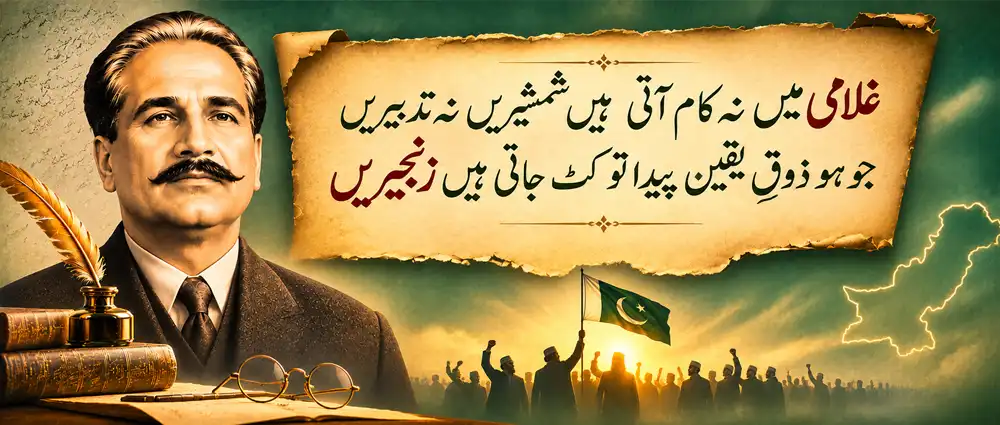
Iqbal explained this idea beautifully in one of his famous lines of poetry:
خودی کو کر بلند اتنا کہ ہر تقدیر سے پہلے
خدا بندے سے خود پوچھے بتا تیری رضا کیا ہے
Important work:
- Bang-e-Dra
- Bal-e-Jibril
- Asrar-e-Khudi
- Rumuz-e-Bekhudi
Role in the creation of Pakistan:
Iqbal also wrote about the challenges Muslims faced and their future in the subcontinent. His 1930 Allahabad Address proposed the strengthening of Muslim-majority provinces in northwestern India into a political unit. Although this was not an exact blueprint for the Pakistan established in 1947, it became an important turning point in the development of Muslim perspectives on politics.
His poetry encouraged Muslims to believe in themselves, stand united, and make their own decisions. He also gave a voice to ideas about Muslim identity, unity, and the future of the community. Often described as the National Poet of Pakistan, he remains one of the most influential figures in Pakistan’s history. Iqbal’s poetry also helps us understand the ideas that contributed to the creation of Pakistan.
2. Altaf Hussain Hali: The Voice of Muslim Social Reform
Altaf Hussain Hali (1837–1914) was an Urdu poet and writer. He supported Sir Syed Ahmad Khan and his work for the improvement of Muslim society. Hali wrote about the problems Muslims faced in education and daily life after the events of 1857. He wanted people to get an education, improve their living conditions, and work towards a better society.
Important works:
- Musaddas-e-Hali (Madd-o-Jazr-e-Islam)
- Hayat-e-Javed
- Muqaddama-e-Sher-o-Shairi
Role in the creation of Pakistan:
His famous poem Musaddas-e-Hali discussed the rise and fall of Muslim civilization. It encouraged readers to look at the problems holding Muslim society back and find ways to improve their conditions. The poem became an important work in Urdu literature and the Muslim reform movement.
Hali did not write about the creation of Pakistan because the demand for a separate country came after his time. His writing focused on education and the need to improve Muslim society. His poetry also shows how writers used Urdu literature to talk about the problems people faced.
3. Maulana Zafar Ali Khan: The Poet Who Used Journalism for Political Awareness
Maulana Zafar Ali Khan (1873–1956) was an Urdu poet and journalist who also took part in political activities. Much of his work appeared in Zamindar, a newspaper that reported on Muslim issues and political events in British India. His poems and articles gave him a way to speak about the problems and concerns of Muslims.
Important work:
- Urdu poetry and political writings.
- Editorial leadership of Zamindar.
- Political speeches and public activism.
Role in the creation of Pakistan:
Zafar Ali Khan used journalism to communicate political developments to a large number of Urdu readers. His newspaper covered Muslim political interests, colonial policies, and important developments affecting the community.
Through his writing, more people learned about political issues, particularly in Punjab, and Muslims became more active in political matters. The contribution of Maulana Zafar Ali Khan shows how newspapers and literature helped people understand social and political issues.
4. Maulana Muhammad Ali Jauhar: A Voice for Muslim Political Rights
Maulana Muhammad Ali Jauhar (1878–1931) was among the Muslim leaders who spoke openly about the rights of their community. He took an active part in the Khilafat Movement and wrote for newspapers such as Hamdard. His articles and speeches often dealt with the political concerns of Muslims.
Important work:
- The Comrade
- Hamdard
- Deewan-e-Jauhar
- Political speeches and Urdu poetry.
Role in the creation of Pakistan:
Jauhar helped mobilize Muslims through the Khilafat Movement and his journalism. He also participated in Muslim political organizations and supported Jinnah’s Fourteen Points after disagreements over constitutional proposals.
Although his political vision was not identical to the later demand for Pakistan, his activism contributed to the development of organized Muslim political consciousness.
An interesting historical detail is that Maulana Muhammad Ali Jauhar was buried in Jerusalem. He died in London in 1931, and his remains were taken to Jerusalem according to his wish.
5. Sir Syed Ahmad Khan: The Intellectual Behind Muslim Educational Awakening
Sir Syed Ahmad Khan (1817–1898) worked to improve the condition of Muslims after the Revolt of 1857. He believed that Muslims needed modern education and knowledge of science to make progress. He encouraged them to study new subjects and take an interest in education. His efforts later became known as the Aligarh Movement.
Important work:
- Asbab-e-Baghawat-e-Hind
- Tahzib-ul-Akhlaq
- Tafsir-ul-Quran
- Establishment of the Muhammadan Anglo-Oriental College.
Role in the creation of Pakistan:
Sir Syed encouraged Muslims to acquire modern education and develop the intellectual skills needed to participate in public life. The institution he established at Aligarh later became Aligarh Muslim University and influenced generations of Muslim scholars and political leaders.
His views increasingly emphasized the distinct political interests of Hindus and Muslims. His reformist thinking contributed to the intellectual background of the Two Nation Theory, although the theory developed through the contributions of several later thinkers and political leaders.
The Services of Sir Syed Ahmed Khan therefore extended beyond education: he helped establish an intellectual foundation for Muslim political awareness.
6. Abu Al-Asar Hafeez Jalandhari: The Poet of Pakistani National Identity
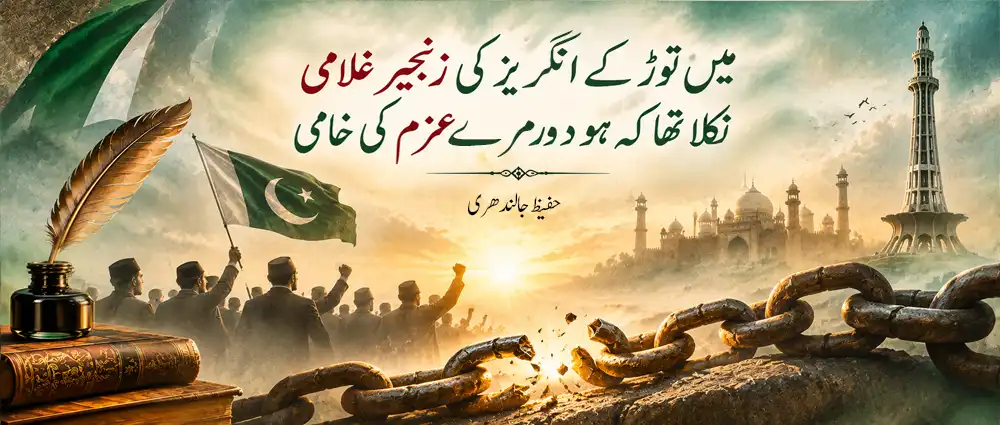
Abu Al-Asar Hafeez Jalandhari (1900–1982) was an Urdu poet and writer. He wrote poems about the country, Muslim history, and Islamic traditions. After moving to Pakistan in 1947, he became part of its literary and cultural life. He is also remembered for writing the national anthem of Pakistan
Important works and contributions:
- Shahnama-e-Islam
- Pakistan’s national anthem.
- Patriotic and national poetry.
Role in Pakistan’s national identity:
Hafeez Jalandhari’s contribution was particularly significant after independence. His four-volume Shahnama-e-Islam presented important episodes from Islamic history through poetry, while his national anthem became a defining expression of Pakistan’s national identity.
One of Hafeez Jalandhari’s best-known contributions was writing Pakistan’s national anthem. The anthem was selected in 1949 and adopted officially in 1954. It became part of the country’s national identity. His work was different from that of earlier writers and poets because he contributed to Pakistan’s cultural life after its creation.
How These Personalities Helped Shape Pakistan’s National Identity
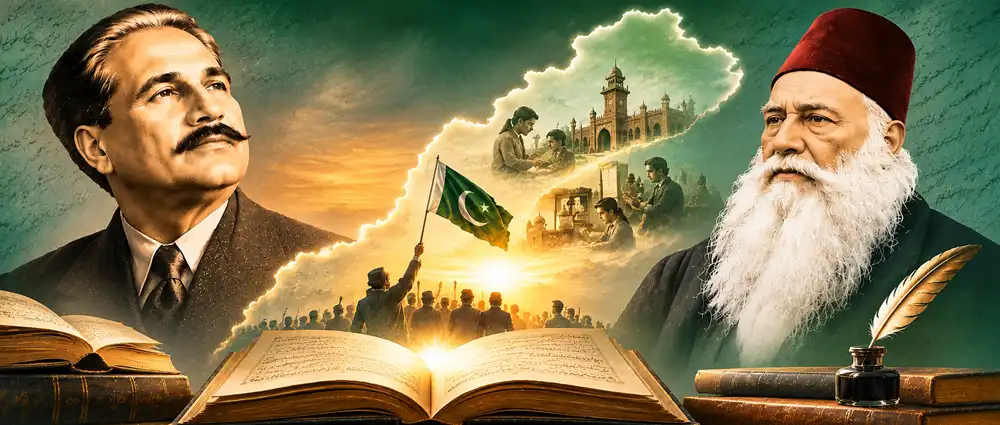
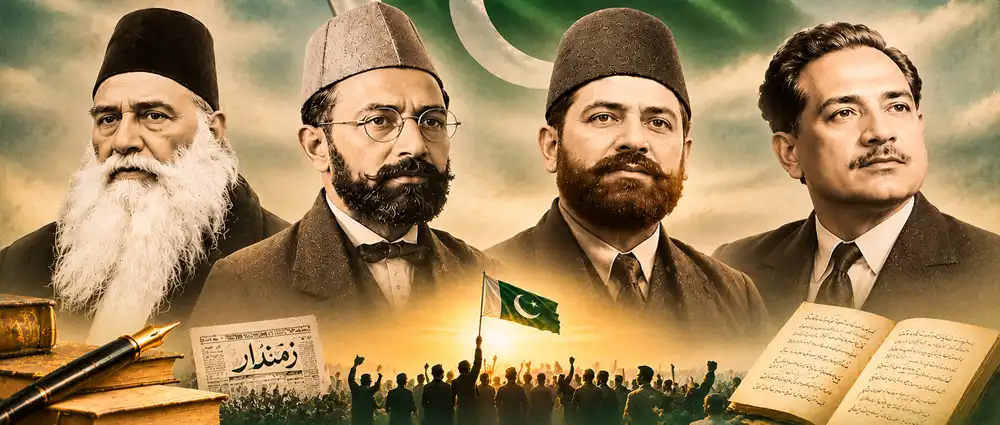
The work of these six personalities shows that the ideas behind Pakistan developed over many years. Sir Syed Ahmad Khan encouraged Muslims to focus on education, while Hali used poetry to write about the problems in Muslim society. Iqbal wrote about Muslim identity and their political future. Zafar Ali Khan and Muhammad Ali Jauhar used newspapers, poetry, and political activities to bring Muslim concerns to more people.
Hafeez Jalandhari made his contribution after Pakistan came into being by writing the country’s national anthem. Each of these figures played a different role in the history of the Poets of Pakistan and the Pakistan Movement.
Their lives and work also show how poetry, education, and journalism became part of the discussions about Muslim identity and political rights. Not all of them directly supported the demand for Pakistan. Some worked towards educational and social change long before the demand for a separate country began.
More Pakistani Poets and Authors Worth Mentioning
Pakistan’s literary tradition continued to develop after independence, producing writers who explored politics, society, identity, love, and human experiences. These famous poets of Pakistan represent a different generation from the intellectuals who influenced the creation of the country.
Some other well-known poets of Pakistan include:
- Faiz Ahmed Faiz: His poetry covered love, social injustice, and the struggles of ordinary people. He also wrote about freedom and resistance, making his work an important part of Urdu literature.
- Ahmad Faraz: He became popular for his romantic ghazals and poems about social issues. His poems are still popular among readers.
- Habib Jalib: He wrote against injustice, inequality, and authoritarian rule. His poems gave voice to people who spoke out for their rights.
- Parveen Shakir: She brought women’s feelings and experiences into her poetry. Love, identity, and relationships remained important subjects in her work.
- Nasir Kazmi: His ghazals often expressed loneliness, memories, and separation. His simple but emotional style made his poetry popular among Urdu readers.
- Jaun Elia: His poems reflected on life, love, loss, and human emotions. His unusual style and thoughtful writing have attracted many young readers.
- Amjad Islam Amjad: Along with poetry, he wrote plays and television scripts. His work often focused on love, relationships, and everyday experiences.
Their work shows that Pakistani poetry is about more than the fight for independence.
Conclusion
The history of Pakistan cannot be understood through political events alone. Poetry, journalism, education, and literature helped shape the intellectual environment in which Muslim political consciousness developed. From Sir Syed Ahmad Khan’s educational reforms to Iqbal’s philosophical vision and Zafar Ali Khan’s journalism, these personalities made different contributions to a wider historical transformation.
The Poets of Pakistan remain an important part of the country’s literary history. Their poetry and writing reflect the ideas, struggles, and hopes of different generations. Their work also shows how writers and poets contributed to discussions about Muslim identity and the creation of Pakistan.