
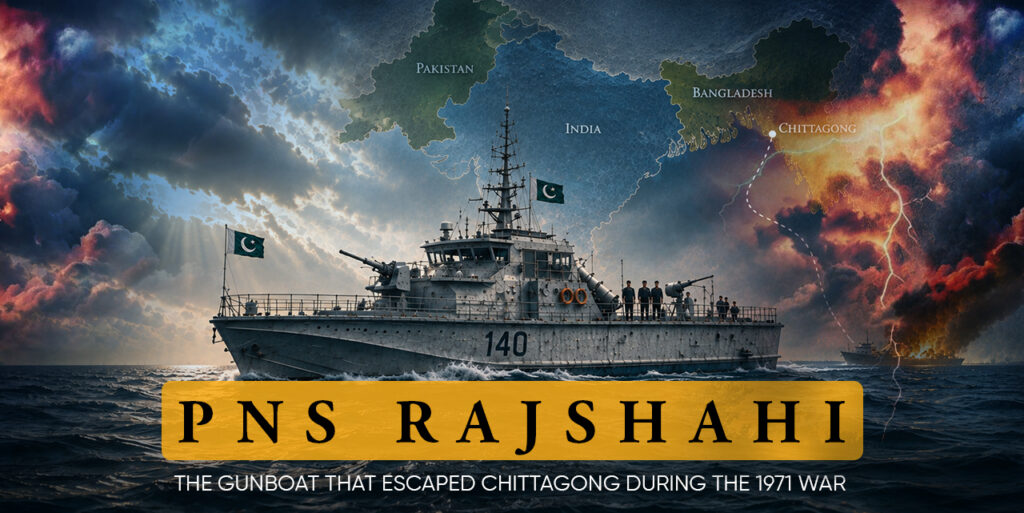
The history of the Pakistan Navy is often told through the stories of frigates, submarines, and other major warships. Yet some of its most remarkable stories belong to smaller vessels. PNS Rajshahi was one such vessel. Built for patrol duties rather than major naval battles, the small gunboat found itself at the center of a rapidly changing conflict in 1971.
From there, the story turned to damage, survival, and a difficult escape. After coming under attack in Chittagong and witnessing the loss of its sister ships, PNS Rajshahi was repaired and prepared to leave East Pakistan. Its crew then attempted a dangerous journey through waters affected by the conflict and blockade, eventually reaching Malaysia before returning to Karachi.
The story of PNS Rajshahi is therefore more than the history of a naval vessel. The story also draws attention to the Pakistan Navy’s river operations and the challenges confronting its personnel during a particularly turbulent chapter in South Asian history.
Key Insights:
- PNS Rajshahi was a small patrol gunboat, but its story became far bigger than its size during the turbulent events of 1971.
- Built for riverine patrols, the vessel suddenly found itself facing attacks, a collapsing naval presence, and the loss of its sister ships.
- After being damaged in Chittagong, PNS Rajshahi faced a critical choice: remain behind, surrender, or attempt a dangerous escape.
- The crew’s journey from East Pakistan to Malaysia and eventually Karachi became one of the most remarkable survival stories associated with the Pakistan Navy during the 1971 war.
- PNS Rajshahi survived when the other vessels of its class were lost, giving the gunboat a unique place in Pakistan’s naval history.
- What happened to PNS Rajshahi after the war reveals how a small surviving vessel continued to carry the memory of a dramatic chapter in the Pakistan Navy’s history.
What we will cover:
- The Origin and Early Service of PNS Rajshahi
- Its role in the Pakistan Navy and riverine operations in East Pakistan.
- What happened to the vessel and its sister ships during the 1971 conflict.
- The attack on PNS Rajshahi at Chittagong and the damage it sustained.
- The daring escape from East Pakistan and journey to Malaysia.
- Its return to Karachi and service after the war.
- The legacy of PNS Rajshahi and why its story still deserves to be remembered.
The Birth of PNS Rajshahi
A Small Gunboat for Riverine Operations
During the 1960s, the Pakistan Navy needed vessels that could operate effectively in rivers, coastal waters and other areas where larger warships were not always practical. The answer was a class of small patrol and gunboats designed for what is often described as brown-water naval operations.
The British shipbuilding industry supplied Pakistan with four vessels of this class, including PNS Rajshahi. Built in Lowestoft and completed in 1965, the ship was relatively modest in size, with its design geared towards practical naval work instead of carrying heavy weapons.
The boat had a steel hull and a relatively light displacement, allowing it to operate in shallow and restricted waters. Its armament was suited to patrol duties, internal security operations, and other limited engagements rather than conventional fleet warfare.
PNS Rajshahi was built for a different kind of naval role. It was meant for patrol duties, providing support, and keeping a naval presence in inland and coastal waters rather than taking on a major fleet or withstanding repeated air attacks.
Commissioning into the Pakistan Navy
On 8 March 1966, PNS Rajshahi was officially commissioned into the Pakistan Navy at Naval Base Chittagong, which was then located in East Pakistan.
Its early service was largely focused on brown-water duties. The vessel patrolled rivers and coastal areas, supported internal security activities and took part in anti-smuggling operations. It could also be used for relief and support work in areas where larger ships had limited access.
For a vessel of its size, these responsibilities were significant. The extensive river systems of East Pakistan created a very different operating environment from the open sea. A small, maneuverable gunboat could reach places that conventional warships could not.
PNS Rajshahi and Its Sister Ships
Image: Rajshahi and four other boats that were present with Rajshahi back then
PNS Rajshahi was part of a four-boat class. Its sister vessels were PNS Jessore, PNS Comilla, and PNS Sylhet.
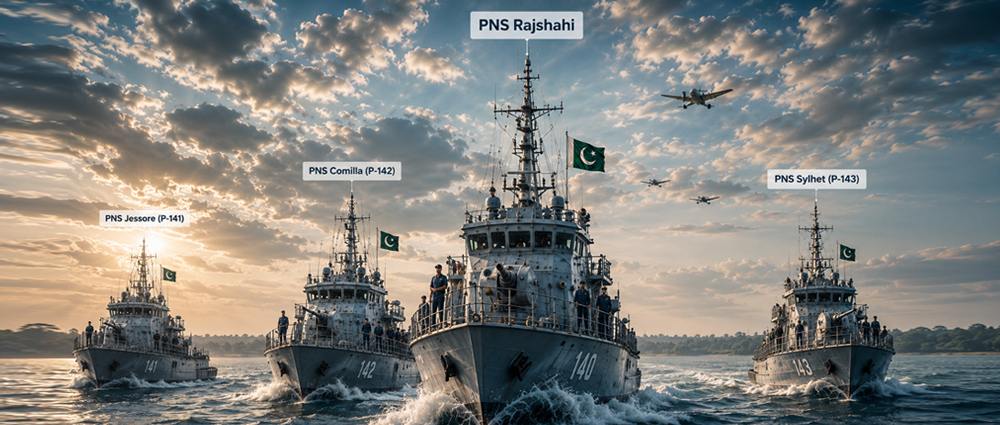
At around 345 tonnes apiece, the four boats could attain speeds of nearly 20 knots. Each carried a crew of roughly 29 sailors, while their relatively light weapons were intended primarily for patrol and security operations.
Together, these boats represented an important part of the Pakistan Navy’s riverine capability in East Pakistan. They could not perform the same role as destroyers or frigates. Instead, they filled a specific role by providing mobility and a naval presence across rivers, estuaries and coastal areas.
That role became increasingly important as political tensions intensified.
The Road to the 1971 War
By 1971, political and military tensions in East Pakistan had escalated dramatically. The crisis eventually developed into a full-scale conflict involving Pakistani military forces and the forces fighting for the creation of Bangladesh, with India becoming directly involved in the war.
The 1971 war transformed the role of vessels such as PNS Rajshahi. A boat originally intended for patrol duties was suddenly operating in a wartime environment where air attacks, blockades and the destruction of naval facilities were real threats.
The situation was particularly difficult for the Pakistan Navy in the eastern theatre. Its naval resources there were limited compared with the forces arrayed against them. The four gunboats and smaller river craft therefore became important for patrols, movement, support and evacuation.
The wider conflict is sometimes referred to in discussions of the 1971 war India Pakistan, reflecting the direct military involvement of India during the final stage of the war.
For the crews aboard these vessels, the change was dramatic. Their normal duties had been replaced by the demands of wartime survival.
PNS Rajshahi During the 1971 Conflict
The Attack on Chittagong
In December 1971, the conflict entered its decisive phase. Naval assets in East Pakistan faced increasing pressure, while Indian air power and naval forces played a major role in isolating the eastern theatre.
On 4 December, Indian air attacks targeted naval assets around Chittagong. PNS Rajshahi and PNS Comilla were attacked in the area.
Rajshahi survived but suffered damage. Comilla was not so fortunate and was sunk.
The attacks demonstrated the vulnerability of the small gunboats. Their size and maneuverability had been useful during patrol operations, but they offered little protection against sustained air attack.
The losses continued over the following days. Other patrol craft and improvised river vessels were destroyed, while the naval situation in East Pakistan became increasingly desperate.
By 11 December, PNS Jessore had also been destroyed while involved in the evacuation of troops. The four boats that had once played an important role in the Pakistan Navy’s riverine operations had been almost completely wiped out.
The Fate of the Other Gunboats
The destruction of PNS Comilla and PNS Jessore left PNS Rajshahi in an increasingly isolated position. PNS Sylhet, the fourth vessel of the class, was also lost during the conflict. As the situation in East Pakistan deteriorated, the small gunboats that had once carried out patrols and support duties were being caught up in a war for which they had never been designed.
For Rajshahi, survival became the immediate concern. The vessel had already been damaged at Chittagong, while its sister ships were being lost one after another. By this stage, the gunboat’s original role had been overtaken by the much more urgent need to remain operational and find a way out of the eastern theatre.
With the other three vessels gone, PNS Rajshahi became the surviving member of the class. Its eventual escape would give the small gunboat a place of its own in the naval history of the 1971 conflict.
The Escape from Chittagong
A Damaged Vessel With One More Journey Ahead
The survival of PNS Rajshahi was only the beginning of its most remarkable chapter.
After the attack, the vessel was repaired. But the strategic situation around Chittagong had become increasingly difficult. As the position in East Pakistan weakened, the navy struggled to protect its facilities and routes out of the region were under threat.
At this point, the crew faced a difficult choice. Remaining in the area carried the risk of destruction or capture. Surrender was another possibility. Instead, under Lieutenant-Commander Sikandar Hayat, the crew attempted to take the damaged gunboat out of East Pakistan.
This was a vastly different task from the routine river patrols for which PNS Rajshahi had been built.
Sailing Through Dangerous Waters
The escape required the crew to navigate through waters affected by the ongoing conflict and blockade. The vessel was vulnerable, having already suffered damage, and the crew had to contend with the possibility of further attacks.
Yet PNS Rajshahi managed to leave East Pakistan.
Its journey eventually took the vessel to Malaysia, where it reached safety. From there, the gunboat later sailed to Karachi and returned to West Pakistan.
The escape gave PNS Rajshahi a unique place in the history of the Pakistan Navy. The vessel had survived an attack that destroyed one of its sister ships, remained operational after suffering damage, and then completed a long and hazardous journey away from the collapsing eastern theatre.
Why the Escape of PNS Rajshahi Matters
The significance of PNS Rajshahi does not come from winning a major naval battle. It did not transform the course of the war or defeat a larger fleet.
Its significance lies elsewhere.
The vessel represents the experiences of smaller naval units that were suddenly required to operate under extraordinary circumstances. The crew had to make decisions with limited resources while the strategic situation around them changed by the day.
The escape also illustrates the importance of adaptability. A vessel built for patrol work had to become, for a short but critical period, a vessel focused almost entirely on survival and navigation.
That makes the story particularly interesting when examining the history of the Pakistan Navy during 1971. Major warships often dominate historical accounts, but smaller craft also carried personnel, provided riverine mobility, and performed essential support duties.
What Happened to PNS Rajshahi After the War?
Returning to Karachi did not mark the end of PNS Rajshahi.
Unlike its sister vessels, the gunboat survived the conflict and continued serving with the Pakistan Navy. Its later responsibilities were less dramatic than its wartime escape. The vessel was used for training and routine naval activities rather than serving as a major frontline combat ship.
As the Pakistan Navy added bigger ships, there was less need for an old gunboat like Rajshahi. Even so, it remained a reminder of the days when small boats played an important role in river operations.
The story also provides an unusual contrast with the wider development of the navy. While larger vessels represented the evolution of maritime warfare, PNS Rajshahi remained a reminder of a period when small patrol craft were essential to operations in East Pakistan.
PNS Rajshahi and the Broader History of 1971
To understand what happened to PNS Rajshahi, we also need to look at what was happening across East Pakistan in 1971. The war was changing the region, and Bangladesh emerged as an independent country.
The period is also closely associated with the emergence of Bangladesh Independence Day, observed on 26 March, while 16 December is commemorated in Bangladesh as Victory Day.
For anyone seeking a concise history of Pakistan, the events of 1971 are an essential part of the country’s political and military history. They also reshaped the Pakistan Army, Pakistan Navy and other branches of the armed forces.
It is important, however, to distinguish between the different institutions and their roles. PNS Rajshahi belongs specifically to the naval history of the conflict rather than the broader history of ground operations.
Likewise, references to the Chief of Army Staff of Pakistan relate to the army’s leadership structure and should not be confused with the command structure of the Pakistan Navy.
Search terms such as Pak ban may also appear in online discussions referring to Bangladesh, but they do not describe the vessel itself or its naval role.
The Legacy of PNS Rajshahi
The Sole Survivor
The loss of PNS Jessore, PNS Comilla and PNS Sylhet left PNS Rajshahi as the surviving member of its class.
That fact alone makes the vessel unusual in Pakistan’s naval history.
Three sister vessels were lost during the conflict, while Rajshahi survived the attacks, underwent repairs and escaped the eastern theatre. Its continued service afterward meant that the story of this small class did not end entirely with the war.
More Than a Warship
The legacy of PNS Rajshahi is ultimately about the people who operated it as much as the vessel itself.
A ship can be built from steel, equipped with weapons and given a name, but its ability to survive depends on the people aboard it. In Rajshahi’s case, the crew had to deal with damage, uncertainty, and an increasingly dangerous environment before attempting to reach safety.
The vessel’s story therefore offers a different perspective on military history. Instead of focusing only on major battles and strategic decisions, it allows us to look at what happened aboard a relatively small vessel caught in the middle of a major conflict.
What PNS Rajshahi Teaches Us About Naval History
The story of PNS Rajshahi highlights several important aspects of naval warfare and military history.
First, small vessels can have important roles even when they lack the capabilities of larger warships. In riverine environments, maneuverability and access can matter as much as size.
Second, wartime roles can change quickly. Rajshahi was designed for patrol and support operations, but the circumstances of 1971 forced its crew to undertake a far more dangerous journey.
Third, survival can become a mission in itself. After its sister ships were destroyed, Rajshahi’s continued existence depended on the decisions made by its crew.
Finally, naval history is not limited to famous battles. The experiences of patrol boats, support craft and their crews can reveal how a conflict was experienced at a much more personal level.
Remembering PNS Rajshahi
Today, PNS Rajshahi remains one of the more unusual stories from the Pakistan Navy’s experience during the 1971 conflict.
It began as a small British-built patrol craft commissioned for service in East Pakistan. It spent its early years performing routine riverine and coastal duties. Then, as political tensions turned into war, the vessel found itself in an increasingly dangerous theatre.
It survived an attack in Chittagong while one of its sister ships was sunk. It later saw the destruction of the remaining vessels of its class. Damaged but still operational, PNS Rajshahi was repaired and prepared for an escape from the eastern theatre.
The journey to Malaysia and eventually Karachi turned the small gunboat into a survivor of a dramatic chapter in naval history.
Its story is not about a spectacular fleet victory. It is about endurance, difficult decisions and the determination of a crew facing extraordinary circumstances.
For this reason, the history of PNS Rajshahi deserves to be remembered alongside the larger stories of the 1971 war and the history of the Pakistan Navy.
Watch the Full Story
Want to explore the escape in greater detail? Watch Rava Studios’ documentary PNS Rajshahi – Escape from Chittagong to follow the vessel’s remarkable journey from the attack in Chittagong to its eventual escape and return to Karachi.