
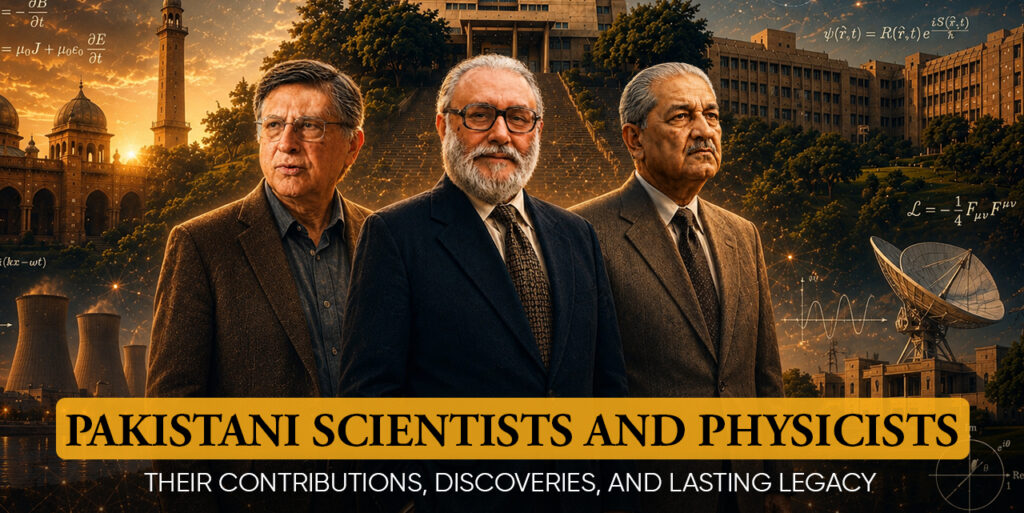
Most people associate Pakistani scientists with Abdus Salam or Abdul Qadeer Khan, but there is much more to Pakistan’s scientific story. Scientists in Pakistan work in many different fields, including physics, engineering, and space science, and many also work with leading research institutions around the world.
Today, Pakistani scientists work in universities, research centers, and international laboratories around the world. Some study particle physics, while others work in nuclear science, space research, materials science, and many other fields. Together, their research continues to add to scientific knowledge at both the national and international level.
Key Insights:
- Pakistan has produced influential physicists whose work has shaped particle physics, nuclear science, space research, and science education.
- Scientists such as Dr. Abdus Salam, Dr. Abdul Qadeer Khan, Dr. Ishfaq Ahmad, Dr. Pervez Hoodbhoy, and Dr. Riazuddin have contributed to both national and international scientific progress.
- Research institutions including PAEC, NCP, PINSTECH, SUPARCO, and ICTP have helped build Pakistan’s scientific ecosystem and global collaborations.
- Pakistani researchers actively contribute to international projects at CERN, including detector development, data analysis, and Large Hadron Collider experiments.
- Physics research in Pakistan supports real-world applications in healthcare, electricity generation, agriculture, satellite technology, communications, and disaster management.
- Despite progress, challenges such as limited funding, brain drain, outdated laboratories, and weak industry collaboration continue to slow scientific growth.
- Emerging fields like quantum technologies, AI, nanotechnology, semiconductors, and fusion research present major opportunities for the next generation of Pakistani scientists and Physicists.
- Strengthening research, education, and public support for science can help Pakistan play a larger role in future global scientific discoveries.
What we will cover:
- How physics has grown in Pakistan since 1947, from the country’s early years to its role in nuclear science and international research.
- The story of physics in Pakistan, from independence to today’s research in nuclear science, space technology, and particle physics.
- Institutions and their roles in research, training, and international collaboration.
- Pakistani contributions to particle physics, including CERN participation and detector development.
- Nuclear physics research: electricity generation, nuclear medicine, agriculture, and industrial applications.
- How SUPARCO has supported Pakistan’s space program through satellites, Earth observation, and disaster monitoring.
- Current research in areas such as quantum technologies, artificial intelligence, nanotechnology, and computational physics.
- The role of physics in everyday life, from healthcare and energy to communications and agriculture.
- The main challenges facing physics research, including limited funding, research facilities, and opportunities for students.
- New areas of research where Pakistani scientists can contribute, including quantum technologies, semiconductor science, AI, and international projects such as CERN.
Why Physics Matters
Physics powers the technology we use every day. It explains how the universe works, from the smallest subatomic particles to the largest galaxies. Every technology we rely on, from smartphones to medical devices to power generation, exists because physicists discovered the basic rules that control how matter and energy work.
While a few Pakistani scientists are famous, many others conduct important research in physics and engineering. They teach, discover, and advance science without public recognition.
The History of Physics in Pakistan
Early Scientific Foundations
When Pakistan became independent in 1947, it had almost no research institutions, few universities, and minimal scientific capacity. Starting from scratch seemed impossible. But Pakistani scientists refused to give up.
In the 1950s, serious efforts began to build scientific institutions. Scientists understood that Pakistan needed physics research, nuclear energy, atomic science, and fundamental physics to shape the country’s future. They started creating the infrastructure and institutions that would support this work.
Building Scientific Institutions
Throughout the 1950s and 1960s, Pakistani scientists worked to establish the foundational institutions that would support future research, like the Pakistan Council of Scientific and Industrial Research (PCSIR), the Pakistan Atomic Energy Commission (PAEC), and SUPARCO. These institutions became the backbone of Pakistan’s scientific progress and attracted some of the brightest minds in the country and beyond.
Pakistan’s Scientific Institutions
Over the decades, Pakistan has established universities, research centers, and national organizations dedicated to advancing science and technology across disciplines such as physics, engineering, medicine, agriculture, and space research:
Pakistan Atomic Energy Commission (PAEC)
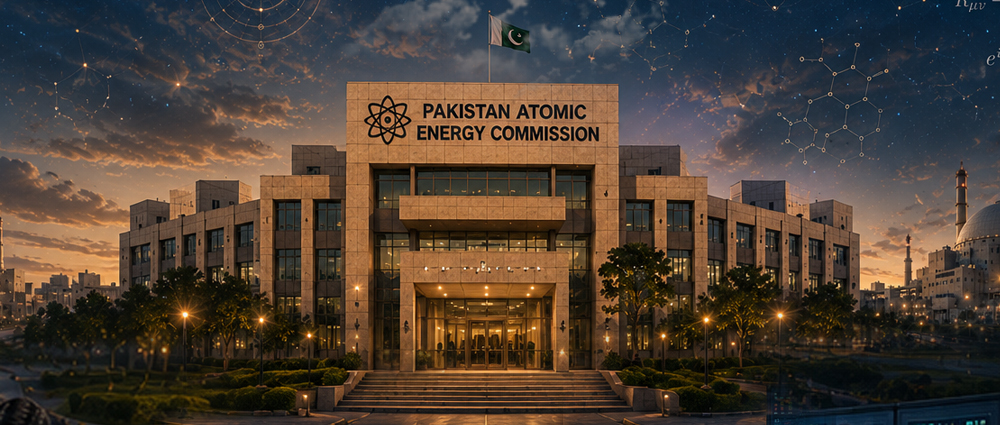
PAEC was established in 1956 for nuclear research. Today, it works in healthcare, agriculture, industry, energy generation, and scientific training.
It works across multiple areas:
- Nuclear power generation.
- Nuclear medicine and radiation therapy.
- Agricultural research using radioisotopes.
- Industrial applications and materials science.
- Engineering research.
- Training new scientists.
PAEC operates research centers, hospitals, nuclear power plants, and training institutes across Pakistan. Scientists like Dr. Ishfaq Ahmad and Dr. Munir Ahmad Khan shaped its research programs.
National Centre for Physics (NCP)
The National Centre for Physics, located near Islamabad, is one of Pakistan’s main centers for physics research. Scientists and students work there in areas such as:
- High-energy physics.
- Particle physics.
- Nuclear physics.
- Plasma physics.
- Quantum optics.
- Computational physics.
- Laser physics.
- Materials science.
NCP organizes conferences and workshops for researchers, works with Pakistani universities, and coordinates Pakistan’s involvement in CERN collaborations and international experiments.
International Centre for Theoretical Physics (ICTP)
Dr. Abdus Salam founded ICTP in Trieste, Italy, in 1964 after recognizing that talented scientists from developing countries lacked opportunities to work with leading international researchers. The center was his solution to this problem.
ICTP provides education, research opportunities, and training programs for physicists worldwide. Thousands of Pakistani scientists have benefited from ICTP programs, fellowships, and collaborations. The institution remains one of Salam’s greatest legacies, demonstrating his commitment to supporting researchers from developing nations.
SUPARCO
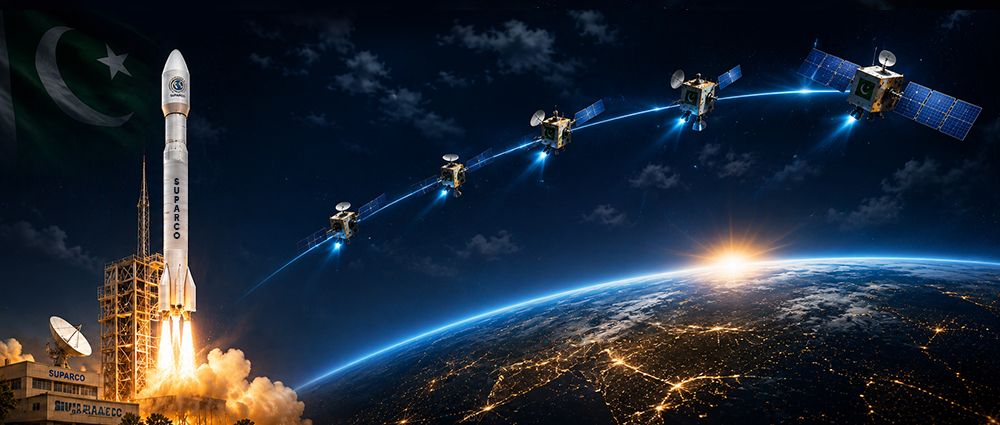
Pakistan established SUPARCO in 1961 to develop space technology. The agency works on:
- Satellite development and launch.
- Space science research.
- Remote sensing and earth observation.
- Atmospheric research.
- Satellite communications.
- Disaster monitoring.
SUPARCO has launched sounding rockets like Rehbar and satellites including Badr-1, Badr-B, PRSS-1, and PakTES-1A. Today, satellite images from SUPARCO help with flood monitoring, urban planning, agricultural planning, and emergency response.
Pakistan Institute of Nuclear Science and Technology
PINSTECH brings together Pakistani scientists working in multiple fields.
- Nuclear engineering.
- Chemistry.
- Materials science.
- Biotechnology.
- Physics.
- Radiation applications.
At PINSTECH, scientists develop technologies and produce medical isotopes for hospitals. The institute also trains younger researchers and engineers, preparing them for scientific careers.
Universities Driving Physics Research
Universities across Pakistan drive physics research:
- Quaid-i-Azam University
- Government College University Lahore
- University of the Punjab
- COMSATS University Islamabad
- NUST
- PIEAS
- LUMS
These institutions conduct research in condensed matter physics, quantum information, plasma physics, semiconductors, and nanotechnology through international collaborations.
Leading Pakistani Physicists
Dr. Abdus Salam: Pakistan’s Nobel Prize Winner
Abdus Salam is Pakistan’s most famous scientist. Born in 1926 in Jhang, a small town in Punjab, he showed mathematical talent early on. He studied at Government College Lahore, then went to Cambridge University. His path from a small town to becoming a world-renowned physicist inspired many Pakistani scientists who came after him.
Major Work and Contribution
Salam developed electroweak theory with Steven Weinberg and Sheldon Glashow, combining electromagnetic and weak nuclear forces. His equations predicted W and Z bosons and showed that at high energies, these forces combine into a single force. This became foundational to the Standard Model of particle physics.
His Lasting Influence on Physics
The electroweak theory of Abdus Salam became foundational to the Standard Model. The 1983 discovery of W and Z bosons confirmed his predictions. The 2012 discovery of the Higgs boson completed his vision.
Physicists around the world use his work today. Pakistani scientists continue drawing on his approach to solve physics problems.
Awards and Recognition
Dr. Abdus Salam received many honors:
- Nobel Prize in Physics – Shared with Steven Weinberg and Sheldon Glashow
- Smith’s Prize – From Cambridge University
- Nishan-e-Imtiaz
His Lasting Legacy
Salam founded the International Centre for Theoretical Physics in Italy to support scientists from developing countries. The center remains one of the world’s leading physics institutions.
He guided young researchers, advocated for science education, and worked to build research institutions in Pakistan. His theoretical work guides modern physics, and his legacy remains central to Pakistan’s scientific identity.
Dr. Abdul Qadeer Khan: A Leading Nuclear Scientist
Abdul Qadeer Khan focused on practical engineering instead of theory. He studied metallurgy and engineering in Pakistan and other countries. In the 1970s, he returned to Pakistan to lead the country’s nuclear program. His work on uranium enrichment showed that Pakistani scientists could solve engineering problems as well as any other nation.
His Major Work and Contributions
Khan developed gas centrifuge technology to enrich uranium and founded Khan Research Laboratories (KRL). He turned theoretical ideas into functioning systems, machines, and materials. While Abdus Salam focused on equations, Khan concentrated on practical technology.
Why His Work Was Revolutionary
After India’s 1971 military victory and subsequent nuclear test in 1974, Pakistan faced strategic pressure. Khan’s uranium enrichment program became crucial to Pakistan’s security. He proved that Pakistani engineers could develop advanced nuclear technology independently, without importing everything from other nations.
Khan’s success inspired many Pakistanis to pursue engineering and contributed to Pakistan’s energy independence. His approach demonstrated that while theory matters, practical engineering and implementation are equally important.
Awards and Recognition
Dr. Khan received national honors:
- Nishan-e-Imtiaz
- Hilal-e-Imtiaz
His Lasting Legacy
Throughout his career, Dr. Abdul Qadeer Khan collaborated with scientists, engineers, and researchers on various projects that enhanced Pakistan’s technical capabilities. Many of those trained during this time went on to further their work in research and engineering.
Dr. Ishfaq Ahmad: Nuclear Researcher and Science Leader
Dr. Ishfaq Ahmad studied physics at Government College, Lahore, then earned his PhD in Nuclear Physics from Université de Montréal in 1959. He worked at CERN before returning to Pakistan in the late 1960s to pursue nuclear research.
His Major Work and Contributions
Ahmad conducted research in reactor physics, nuclear engineering, and particle physics, developing technologies for peaceful nuclear applications. He served as Director of PINSTECH and PAEC’s Lahore Center before becoming PAEC Chairman.
Beyond research, Ahmad strengthened science education by connecting universities and research centers. He established the National Center for Nuclear Physics at Quaid-e-Azam University and represented Pakistan at the International Atomic Energy Agency, advancing Pakistan’s international scientific partnerships.
His Lasting Influence on Physics
Ahmad strengthened Pakistan’s scientific institutions by negotiating agreements with CERN and other international organizations. He connected Pakistani scientists to global research projects and gave them access to advanced facilities.
He also advocated for peaceful uses of nuclear technology and supported research on climate change and earthquakes, demonstrating that nuclear science extends beyond energy to environmental challenges.
Awards and Recognition
Dr. Ahmad received two of Pakistan’s highest civilian awards:
- Nishan-e-Imtiaz
- Hilal-e-Imtiaz
His Lasting Legacy
Ahmad built institutions by negotiating CERN agreements in 1997 and 2000 that brought Pakistani scientists into Large Hadron Collider research. Since 2001, he has taught advanced physics and mentored younger scientists. He also established research centers for climate change and earthquake studies.
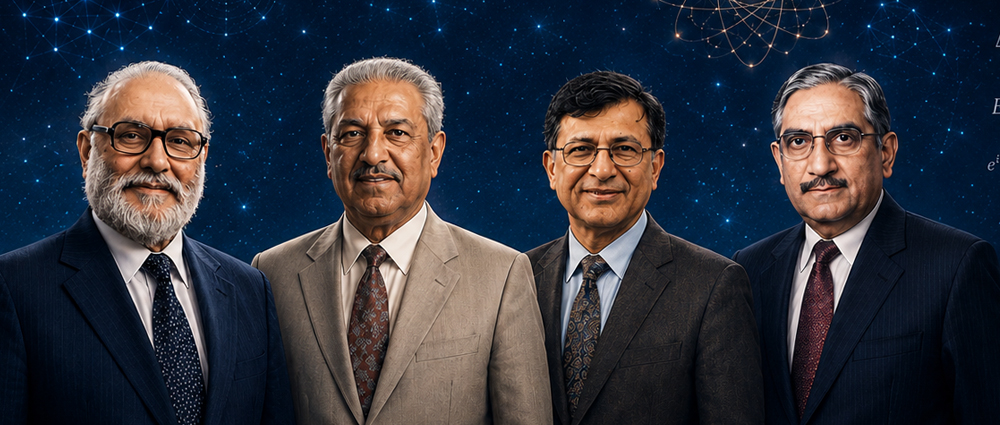
The three scientists played different roles: Abdus Salam made theoretical discoveries, Abdul Qadeer Khan engineered practical systems, and Ishfaq Ahmad built institutions where other scientists could work.
Riazuddin: Theoretical Physicist and ICTP Scholar
Riazuddin was trained by Abdus Salam and earned his PhD from Cambridge in 1959. After working internationally, he returned to Pakistan as founding Director of the National Center for Physics (1999-2013), continuing Salam’s legacy of theoretical physics excellence.
His Major Work and Contributions
Riazuddin published over 165 research papers and wrote influential textbooks on particle physics and quantum mechanics that are used worldwide. He co-edited “Selected Papers of Abdus Salam,” preserving his mentor’s scientific legacy.
His Lasting Influence on Physics
Riazuddin worked at King Fahd University in Saudi Arabia and held visiting positions in the United States. Through ICTP, he collaborated internationally and brought that expertise back to Pakistan’s research community.
Awards and Recognition
Dr. Riazuddin received many honors:
- UNESCO Albert Einstein Gold Medal for Fundamental Science.
- Gold Medal of the Pakistan Academy of Sciences.
- Tamgha-e-Imtiaz and Hilal-e-Imtiaz.
Lasting Legacy
Dr. Riazuddin was the founding Director of the National Center for Physics (NCP), which continues to support physics research in Pakistan. The center works with international organizations such as CERN and ICTP, giving Pakistani scientists opportunities to take part in global research projects. His books are still used by many physics students, and his research continues to be referenced by scientists today.
Dr. Samar Mubarakmand: Nuclear Physicist and Institution Builder
Dr. Samar Mubarakmand studied physics at Government College, Lahore, where he completed his Master’s degree in 1962. He later continued his studies at the University of Oxford and earned an M.Phil. in Experimental Nuclear Physics in 1966 before returning to Pakistan.
His Major Work and Contributions
Mubarakmand researched neutron spectroscopy and led the 1978 construction of a linear particle accelerator at PINSTECH. He developed fiber-optic technology in Pakistan and headed the scientific team for the 1998 Chagai nuclear tests.
His Lasting Influence on Physics
Mubarakmand founded NESCOM, supporting research in electronics, wireless communication, fluid dynamics, computational science, and advanced materials. He organized international conferences connecting Pakistani and global scientists.
Awards and Recognition
Dr. Mubarakmand received national honors including:
- Hilal-e-Imtiaz
- Sitara-e-Imtiaz
His Lasting Legacy
Dr. Samar Mubarakmand has remained active in scientific projects after his work in nuclear research. He has been associated with the Thar coal project and has also served as Chairman of the Punjab Mineral Company. His work today focuses on energy and mineral development in Pakistan.
Dr. Pervez Hoodbhoy: Scientist and Public Intellectual
Dr. Pervez Hoodbhoy studied at the Massachusetts Institute of Technology (MIT), where he completed degrees in mathematics, electrical engineering, solid state physics, and nuclear physics. He later returned to Pakistan and taught physics at Quaid-e-Azam University for about 40 years before joining FC College in Lahore as Professor of Physics and Mathematics.
His Major Work and Contributions
Dr. Pervez Hoodbhoy’s research includes nuclear physics, quantum mechanics, and particle physics. Alongside his research, he has written books on science and education, produced television programs, and led Urdu book translation projects through Mashal Books. He has also taught at universities in Pakistan and abroad and has spoken about the need for better science education and research in the country.
His Lasting Influence on Physics
Dr. Pervez Hoodbhoy has shared science with a wider audience through his books, documentaries, newspaper articles, and public talks. His work has helped many people understand science in a simple way.
Awards and Recognition
Dr. Hoodbhoy has received several awards and honors:
- UNESCO Kalinga Prize for Popularization of Science.
- Joseph A. Burton Award from the American Physical Society.
His Lasting Legacy
Alongside his research, Dr. Pervez Hoodbhoy has worked to make science easier for the public to understand. Through his books, television programs, newspaper articles, and Mashal Books, he has shared scientific ideas with a wider audience. He has also served on international panels discussing science and disarmament.
Dr. Ghulam Murtaza: Plasma Physics and Fusion
Murtaza studied physics at Government College University, Lahore, then earned his PhD in Theoretical Physics from Imperial College London in 1966 under Abdus Salam.
His Major Work and Contributions
Murtaza initially researched particle physics under Abdus Salam before shifting to plasma physics and fusion. At PAEC and Quaid-i-Azam University, he founded the Fusion Laboratory and published fusion research internationally. He collaborated with ICTP on fusion studies and led Pakistan’s National Tokamak Fusion Program (2007-2008), overseeing installation of the GLAST tokamak at PINSTECH.
His Lasting Influence on Physics
Murtaza advanced Pakistan’s plasma physics and fusion research. From 2000 to 2020, he directed the Abdus Salam Chair in Physics at Government College University, established the National Center for Mathematics, and mentored young physicists.
Awards and Recognition
Dr. Murtaza received the following honors:
- Sitara-e-Imtiaz.
- Khwarizmi International Award.
His Lasting Legacy
Dr. Ghulam Murtaza established the Fusion Laboratory at Quaid-i-Azam University. He later led Pakistan’s National Tokamak Fusion Program at PINSTECH and also worked at the Abdus Salam Chair in Physics at Government College University.
Dr. Faheem Hussain: Theoretical Physicist and String Theory Researcher
Dr. Faheem Hussain completed his early studies in Lahore and then went to the UK. He completed a PhD in Theoretical Physics under Abdus Salam’s guidance.
His Major Work and Contributions
Dr. Faheem Hussain was the first Pakistani physicist to publish superstring theory research. He worked internationally at the Enrico Fermi Institute, CERN, DESY, and ICTP. In 2004, he returned to Pakistan, joining NCP before moving to LUMS, where he founded the Mathematical Physics Group.
His Lasting Influence on Physics
At ICTP, Hussain taught in the diploma program, training students from developing countries. After returning to Pakistan, he founded the Mathematical Physics Group at LUMS and conducted superstring theory research.
Awards and Recognition
Most of Dr. Faheem Hussain’s research was in superstring theory and mathematical physics. He also taught at universities in Pakistan and abroad and published his work in international journals.
His Lasting Legacy
At LUMS, Hussain founded the Mathematical Physics Group. Beyond academic work, he engaged in public scientific discussions. He died on September 29, 2009, leaving a legacy that continues inspiring physicists and mathematicians in Pakistan.
Other Notable Pakistani Physicists
Pakistan has produced many accomplished physicists whose contributions deserve recognition alongside the country’s best-known names.
Munir Ahmad Khan
In 1972, Prime Minister Zulfikar Ali Bhutto assigned Munir Ahmad Khan as Chairman of PAEC. He led the country’s early nuclear program and expanded research in nuclear engineering, reactor technology, medicine, agriculture, and energy. He also helped establish the National Development Complex (NDC), which later played a role in Pakistan’s missile program.
Nergis Mavalvala
Professor Nergis Mavalvala, a Pakistani-born astrophysicist at the Massachusetts Institute of Technology, is known for her study on the Laser Interferometer Gravitational-Wave Observatory (LIGO). She was part of the LIGO team that detected gravitational waves produced by two colliding black holes in 2016, confirming a prediction Albert Einstein had made decades earlier.
Emerging Researchers
Many young Pakistani scientists are working in areas such as quantum computing, plasma physics, semiconductors, artificial intelligence (AI), nanotechnology, and accelerator research. Many also work with organizations such as CERN, the National Centre for Physics (NCP), ICTP, and the International Atomic Energy Agency (IAEA) through joint research projects.
Pakistan’s Contributions to Particle Physics
Understanding Particle Physics
Particle physics looks at the smallest parts of matter and the forces that act on them. It helps scientists understand what everything around us is made of and how these tiny particles behave.
Research in this field has led to the Standard Model, which is the main theory used to explain the particles and forces studied in particle physics. Another major milestone came with the discovery of the Higgs boson(fundamental particle), which supported predictions scientists had made years earlier.
Dr. Abdus Salam’s Contribution to Particle Physics
Dr. Abdus Salam is best known for his work on the electroweak theory, which guides modern physics research on particles. This theory explains the connection between the electromagnetic force and the weak nuclear force, two of the basic forces found in nature.
When scientists tested the electroweak theory at CERN, they confirmed Salam’s predictions. They found the W and Z bosons in 1983, exactly as he predicted. After discovering the Higgs boson in 2012, this discovery validated Salam’s predictions from years earlier. His work guides modern physics research.
Collaboration of Pakistani Scientists with CERN
CERN, located near Geneva, is one of the world’s largest particle physics laboratories. Researchers representing more than 100 nations conduct experiments there that explore the smallest particles in nature. The laboratory is also home to the Large Hadron Collider (LHC), the world’s largest particle accelerator.
Pakistani scientists first connected with CERN in the early 1990s. In 2015, Pakistan became an Associate Member State, which meant Pakistani researchers could participate directly in CERN experiments and contribute to major projects.
Pakistani scientists work on:
- CMS (Compact Muon Solenoid).
- ALICE (A Large Ion Collider Experiment).
- Detector upgrades and new components.
- Accelerator engineering and technology.
- Computing systems that process experimental data.
- Data analysis and interpretation.
- Advanced electronics for precision instruments.
Through these projects, Pakistani researchers work with scientists from around the world while contributing to international particle physics research.
Pakistan’s Role in the Large Hadron Collider (LHC)
CERN operates the Large Hadron Collider, the biggest particle accelerator ever built. It speeds up tiny particles called protons and brings them into collision inside large detectors. By studying these collisions, scientists can learn more about particles and the forces that govern them.
Pakistan doesn’t operate the LHC, but Pakistani scientists contribute to CERN projects. They work on detector systems, electronics, data analysis, and computing infrastructure that make the experiments possible.
Detector Development
Pakistani researchers have contributed to different parts of the CMS detector, including:
- Resistive Plate Chambers (RPCs)
- Detector alignment systems
- Precision electronics
- Calibration methods
- Performance monitoring systems
These systems help the detector record and measure particle collisions more accurately.
Pakistan’s Technical Contributions to CERN
Pakistan operates a Tier-2 computing center within the Worldwide LHC Computing Grid that stores and processes data from CERN experiments. This allows researchers in Pakistan and worldwide to analyze LHC results. Tier-2 centers like Pakistan’s now provide over 50% of the computing power needed by LHC experiments.
Beyond computing infrastructure, Pakistani engineers contribute to CERN research through accelerator technology, detector hardware, precision manufacturing, and scientific instruments. NCP coordinates these technical activities, facilitating Pakistan’s engineering participation in CERN collaborations.
National Centre for Physics
NCP coordinates Pakistan’s participation in multiple physics fields, including high-energy physics, experimental and theoretical particle physics, and international collaborations with CERN. The center serves as the institutional hub linking Pakistani researchers to global scientific initiatives.
NCP carries out research in:
- High-energy physics
- Experimental and theoretical particle physics
- Accelerator science
- Computational modelling
- Plasma physics.
NCP organizes workshops and training programs that connect Pakistani scientists with international collaborators.
Pakistani Scientists in Particle Physics
Particle physics has been one of the major research areas for many Pakistani physicists. Some focused on theoretical research, while others worked in teaching, experiments, and international collaborations.
- Dr. Abdus Salam developed the electroweak theory, which later became part of the Standard Model of particle physics.
- Dr. Riazuddin worked in theoretical particle physics and quantum field theory. He also taught at universities and helped establish the National Center for Physics.
- Dr. Faheem Hussain carried out research in superstring theory, quantum chromodynamics, and mathematical physics. He also taught and worked with students in Pakistan and abroad.
- Dr. Pervez Hoodbhoy has conducted research in nuclear and particle physics while teaching physics and writing about science for a wider audience.
Their work continues to be part of research carried out in universities and laboratories in Pakistan and abroad.
Nuclear Physics in Pakistan
Image: showing nuclear physics & Pakistan Atomic Energy Commission
What Is Nuclear Physics?
Nuclear physics studies the nucleus of atoms, the incredibly dense center containing protons and neutrons. This field addresses questions about nuclear stability, radioactivity, nuclear reactions, and the forces holding nuclei together.
Nuclear physics is used in power generation, healthcare, agriculture, industry, and scientific research. In Pakistan, it has become an important part of these fields.
Pakistan Atomic Energy Commission
The Pakistan Atomic Energy Commission (PAEC) was established in 1956 to promote peaceful nuclear research in Pakistan. Over the years, its work has expanded into several areas, including:
- Nuclear power generation
- Medicine, including cancer diagnosis and treatment
- Agricultural research
- Industrial applications
- Water resource management
Today, PAEC operates research centers, hospitals, and nuclear power plants across Pakistan. Its scientists, engineers, and healthcare professionals support research and provide services in energy, medicine, agriculture, and industry.
Important Pakistani Scientists in Physics
Several scientists played different roles in the development of nuclear physics in Pakistan:
- Dr. Munir Ahmad Khan led the Pakistan Atomic Energy Commission (PAEC) and expanded its research programs.
- Dr. Abdul Qadeer Khan worked on uranium enrichment and nuclear engineering.
- Dr. Ishfaq Ahmad carried out research in nuclear physics and later led PAEC.
- Dr. Samar Mubarakmand worked in experimental nuclear physics and engineering projects.
- Dr. Riazuddin contributed to theoretical physics and supported nuclear research.
Together, their work covered research, engineering, leadership, and scientific education.
Nuclear reactors
Pakistan operates several nuclear power plants that generate electricity for the nation:
- Karachi Nuclear Power Plant (KANUPP): Pakistan’s first nuclear power plant, which began operating in 1972. It introduced nuclear power generation in the country.
- Chashma Nuclear Power Plants: A group of nuclear reactors built in later years to increase electricity production. They continue to supply power to Pakistan’s electricity network.
Pakistani scientists and engineers manage these facilities, ensuring safe and efficient operation. They conduct research on reactor engineering, fuel development, and safety systems.
Nuclear Medicine
Hospitals in Pakistan use nuclear physics in several areas of healthcare. Some of the main applications include:
- Cancer treatment: Radioactive isotopes, including cobalt-60, are used to treat certain cancers.
- PET scans: Small amounts of radioactive tracers help doctors examine organs and detect diseases.
- Medical isotopes: Research reactors produce isotopes used for imaging and cancer treatment.
- Radiotherapy: This treatment uses radiation to target cancer cells and reduce the size of tumors.
These medical applications show how nuclear physics is used beyond energy generation and scientific research.
Agricultural Applications
Nuclear physics is also used in agriculture. In Pakistan, radioisotopes support farming and food research in several ways:
- Improving crop varieties: Radiation is used to develop crops with better yields and greater resistance to drought and disease.
- Pest control: Scientists use radiation to sterilize insects, helping reduce pest populations without relying on pesticides.
- Food preservation: Food irradiation helps extend shelf life and reduces spoilage by limiting the growth of harmful microorganisms.
The Chagai Tests: Scientific Perspective
In 1998, Pakistan launched underground nuclear tests at Chagai, Balochistan. The operation involved scientists, engineers, and technical teams working together to plan, monitor, and record the tests.
The work included:
- Underground testing: The devices were tested deep underground to contain the explosion and collect scientific data.
- Instrumentation: Sensors recorded pressure, temperature, radiation, and other measurements during the tests.
- Engineering: Engineers developed the systems used for timing, triggering, communication, and data recording.
- Diagnostics: The collected data was analyzed to study the performance of the tests and verify the results.
Space Physics and SUPARCO
SUPARCO: Asia’s First Space Agency
Pakistan created SUPARCO in 1961, making it one of Asia’s earliest space agencies. This happened before many developed countries even started their space programs.
SUPARCO began with modest capabilities but quickly developed expertise in space science and satellite technology. Pakistani scientists working at SUPARCO pioneered space research in South Asia.
Early Achievements
Upper Atmosphere Research
Pakistani scientists also used sounding rockets to study the upper atmosphere. These rockets carried scientific instruments that collected information on temperature, air pressure, and the composition of the atmosphere at different heights.
The Rehbar Sounding Rocket Program
The Rehbar sounding rockets were among Pakistan’s earliest space research projects. They were used to study the upper atmosphere and ionosphere by collecting scientific data that provided data for atmospheric studies.
Satellites:
Pakistan has launched several satellites:
- Badr-1 (1990) – Pakistan’s first satellite; showed the country could build space technology.
- Badr-B – Provides phone and TV service to remote villages.
- PRSS-1 – Earth observation satellite for monitoring land and the environment.
- PakTES-1A – Imaging satellite for research and national use.
- Communication satellites: These satellites support telephone, television, internet, and data services, especially in places with limited communication infrastructure.
Satellite data is used to monitor disasters, support farming, plan cities, and improve communication services.
How Satellite Data Is Used in Pakistan
Satellite images help scientists and government agencies study changes on the Earth’s surface. In Pakistan, they are used in several practical ways:
- Disaster monitoring: During floods and other emergencies, satellite images show which areas have been affected and where relief is needed.
- Flood mapping: Researchers compare satellite images to measure the spread of floodwater and follow changes as water levels rise or fall.
- Agriculture: Crop conditions, irrigation needs, and pest damage can be checked using satellite images before field inspections are carried out.
- Urban planning: Planners rely on satellite images when mapping land, expanding roads, and studying how cities change over time.
Space Physics Research
Pakistani researchers study different areas of space physics that support communication, weather research, and Earth observation. Some of the main research areas include:
- Ionosphere: Scientists study the ionosphere to better understand radio signals, satellite communication, and space weather.
- Atmospheric physics: Research focuses on the Earth’s atmosphere, including weather patterns, air quality, and climate.
- Satellite communication: Scientists work on technologies that improve communication, navigation, and data transmission through satellites.
- Remote sensing: Satellite images are used to study the Earth’s surface for agriculture, disaster management, environmental monitoring, and other research.
International Collaborations
SUPARCO works with several international space agencies, including China, on satellite and space research projects. These partnerships give Pakistani scientists opportunities to work with advanced technologies and take part in joint research.
Pakistani researchers also attend international space science conferences and publish their findings in research journals, helping them share their work with the global scientific community.
Modern Physics Research in Pakistan
High-Energy Physics Research
At the National Centre for Physics and Pakistani universities, scientists study the basic nature of matter. They combine theoretical research with practical experiments and work with scientists worldwide.
Research topics include:
- Phenomenology (predicting experimental outcomes)
- Theoretical particle physics
- Analysis of data from CERN experiments
- Development of new theoretical models
Quantum Physics and Quantum Information
Quantum physics is an emerging research area in Pakistan with applications in computing, cryptography, and sensing. Universities, the National Center for Physics (NCP), and PINSTECH are carrying out research in this field.
Their work includes:
- Laser development: Building and improving laser systems.
- Nonlinear optics: Studying how lasers interact with different materials.
- Materials processing: Using lasers for cutting, welding, and surface treatment.
- Laser–matter interactions: Examining how laser light affects different materials.
Nanotechnology
Nanotechnology is an expanding area of research in Pakistan. Scientists are studying materials at the nanoscale and exploring their use in different fields. Their work includes:
- Nanomaterials: Developing and studying new nanomaterials.
- Nanostructures: Examining the properties and behavior of nanoscale structures.
- Electronics and medicine: Finding new applications for nanotechnology in healthcare and electronic devices.
- Environmental solutions: Using nanoparticles to help remove pollutants from air, water, and soil.
Research in Condensed Matter Physics
Pakistani scientists study the physical properties of solids and other materials to better understand their behavior and improve their use in modern technologies.
- Semiconductors – semiconductor devices and their applications in electronics.
- Superconductors – superconductivity and materials that conduct electricity without resistance.
- Materials Science – development and characterization of advanced materials for industrial and technological applications.
Plasma Physics Research in Pakistan:
Pakistani scientists study plasma physics for both scientific research and practical applications. Their work includes:
- Fusion energy: Research on plasma behavior to support future fusion energy technologies.
- Industrial applications: Using plasma in manufacturing, materials processing, and other industrial technologies.
- Plasma diagnostics: Instrumentation and techniques for measuring plasma properties.
Computational Physics
Computational physics is a growing field where Pakistani scientists use:
- Simulations – simulating physical systems and complex phenomena
- AI – applying artificial intelligence to physics problems and data analysis
- Scientific computing – computational methods and advanced algorithms for physics research
International Research Collaborations
Pakistani physicists work with several international research organizations, giving them access to advanced facilities and opportunities to collaborate with scientists from around the world.
- CERN (Particle Physics): Pakistan became an Associate Member State in 2015. Pakistani scientists contribute to detector development, data analysis, and computing projects.
- ICTP (Theoretical Physics): Founded by Abdus Salam, the International Centre for Theoretical Physics offers research programs, training, and fellowships for scientists from Pakistan and other developing countries.
- IAEA (Nuclear Science): The International Atomic Energy Agency supports research, technical training, and the peaceful use of nuclear technology.
- SESAME (Synchrotron Research): This regional research center gives Pakistani scientists access to synchrotron facilities and collaborative scientific projects.
Challenges in the Pakistani Science and Physics Landscape
Pakistan has made important progress in physics, but researchers continue to face several challenges.
- Limited research funding: Pakistan spends a much smaller share of its GDP on research and development than many developed countries, limiting long-term scientific projects.
- Brain drain: Many physicists move abroad for better funding, research facilities, and career opportunities, highlighting broader challenges around professional opportunities in Pakistan.
- Research facilities: Pakistan has research centers such as NCP and PINSTECH, but access to large experimental facilities is limited compared with laboratories like CERN, Fermilab, and DESY.
- Industry links: Physics research rarely leads to commercial products because collaboration between universities and industry remains limited.
- Public awareness: Most people know Dr. Abdul Qadeer Khan, while scientists such as Dr. Riazuddin, Dr. Faheem Hussain, and Dr. Ghulam Murtaza are less widely recognized.
Challenges in Physics Education
Physics education in Pakistan still faces several practical challenges:
- Outdated curriculum – Universities do not teach recent physics developments.
- Limited laboratory facilities – Schools lack modern equipment for practical work.
- Research training – Few opportunities for research projects and scientific writing.
- Teacher shortages – Experienced physics teachers emigrate, leaving fewer mentors.
- Limited mentorship – Few chances to work with experienced researchers.
- Limited international experience – Students rarely attend conferences or collaborate globally.
Publication Challenges:
Many Pakistani scientists struggle to publish their research. They face these challenges:
- Access to journals: Many universities cannot afford expensive scientific journals and research databases.
- Conference funding: Limited funding makes it harder for researchers to attend international conferences and present their work.
- Academic writing: Publishing in English-language journals can be challenging for some researchers.
- Global Recognition: Limited international collaborations mean fewer people around the world learn about Pakistani research.
The Future of Physics in Pakistan
Physics research in Pakistan is expanding into emerging fields. Quantum technologies, AI applications, and semiconductor research offer opportunities for Pakistani scientists to contribute through research and international collaboration.
Quantum Technologies
Quantum computing, cryptography, and sensing are developing rapidly. Pakistani scientists can contribute through research, international partnerships, and university projects.
Artificial Intelligence in Physics
AI and machine learning are advancing physics research. Pakistani scientists increasingly use these techniques for data analysis, allowing Pakistani researchers to work on global problems with limited resources.
Semiconductor Research
Semiconductor technology is evolving globally. Pakistani researchers can participate by studying materials, improving chip design, and collaborating internationally.
Pakistan’s Growing Role at CERN
Pakistani scientists are increasingly active at CERN. They now handle important work on detectors, data analysis, and computing infrastructure.
Future areas of collaboration may include:
- Upgrades for the High-Luminosity Large Hadron Collider (HL-LHC).
- Developing detector technologies for future particle physics experiments.
- Expanding computing infrastructure to process and analyze research data.
- Leading research groups and contributing to international scientific collaborations.
Pakistani scientists’ experience in CERN projects provides a foundation for deeper future participation.
Fusion Energy Research
Fusion energy research is advancing globally through projects like ITER (International Thermonuclear Experimental Reactor) and programs in China, the US, and Europe. Pakistani scientists can contribute through plasma physics research, materials science, and collaboration with international fusion centers.
Space Research Expansion
Pakistan’s space program is growing as SUPARCO continues to develop new satellite projects and strengthen its research capabilities. This growth is creating more opportunities for scientists to work in areas such as remote sensing, Earth observation, satellite technology, and space science.
Physics Education and Research Opportunities in Pakistan:
Pakistan is expanding physics education through universities and research centers. Students work on research projects, learn from experienced scientists, and connect with global research communities. This helps them build skills for science careers.
- The National Centre for Physics offers research projects, specialized training, and learning opportunities for students and early-career researchers.
- Universities across Pakistan continue to expand their physics departments and research programs, giving students more opportunities to study advanced topics.
- International scholarships through organizations such as ICTP allow Pakistani students and researchers to pursue higher studies and research abroad.
- Global research partnerships with leading scientific institutions enable Pakistani physicists to take part in international projects and exchange knowledge with researchers worldwide.Let me know if there is anything else I can help you with.
How Pakistani Physicists Help Us Today
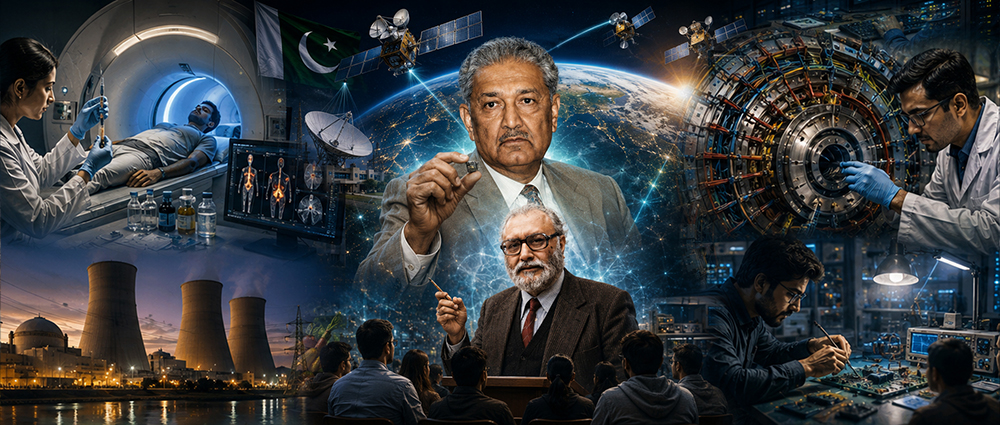
Pakistani physicists contribute to everyday technologies and services:
- Nuclear Medicine – Pakistani scientists produce radioisotopes that doctors use to treat cancer and diagnose diseases.
- Electricity Generation – Nuclear power plants at Karachi and Chashma generate power for Pakistani communities.
- Satellite Communications – SUPARCO satellites provide phone and internet service to remote areas.
- Scientific Computing – Pakistani engineers run a computing center that analyzes data from CERN experiments worldwide.
- Detector Technology – Pakistani scientists developed detector components for CERN experiments.
- Industrial Applications – Radiation helps create crops that produce more food and resist disease. Materials testing improves industrial quality.
- Science Education – Pakistani scientists mentor researchers and inspire future scientists through international collaborations.
Conclusion
Pakistan has produced many respected physicists who have worked in nuclear physics, particle physics, space science, and other areas of research. Their work has supported scientific progress in Pakistan and has also been recognized in laboratories and universities around the world.
Scientists such as Dr. Abdus Salam, Dr. Abdul Qadeer Khan, Dr. Ishfaq Ahmad, Dr. Riazuddin, and Dr. Samar Mubarakmand made different contributions during their careers. Today, Pakistani researchers continue to work at institutions such as CERN, the National Center for Physics, and universities in Pakistan and abroad.
Although Pakistan has made progress, there is still room to improve research funding, laboratory facilities, and physics education. Greater public awareness and continued support for science can help future researchers build on the work of earlier generations and contribute to discoveries.
Discover Rava Studios‘ documentary on Pakistani physicists like Dr. Pervez Hoodbhoy: The Last Rationalist to learn about their stories and global scientific contributions.