
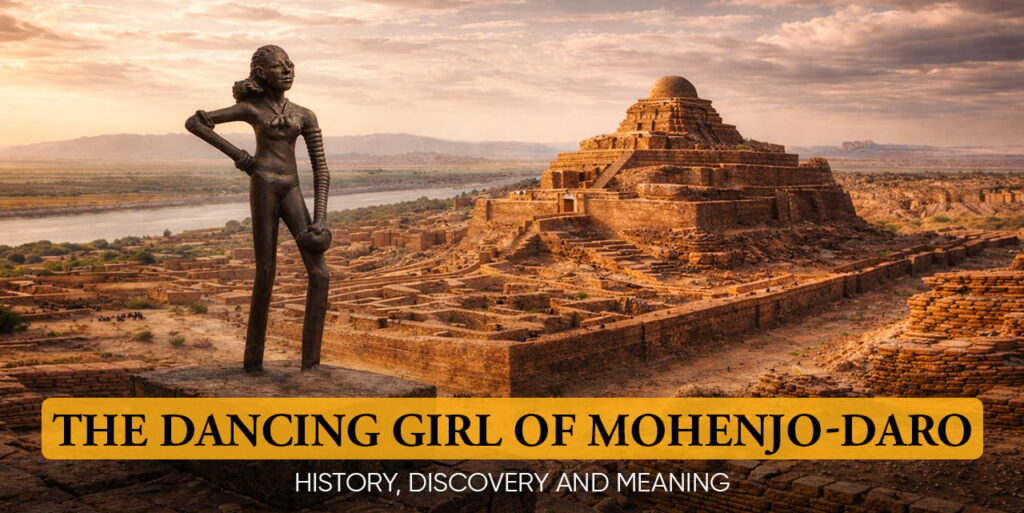
She looks no older than fifteen, standing there with bangles covering her arm and nothing else. In that moment, she is completely sure of herself and the world around her. There is truly nothing else like her anywhere in the world.”
British Archaeologist, 1973
Imagine holding something in the palm of your hand, a small bronze figure no taller than a pen, and realizing that it was crafted over 4,500 years ago by a civilization that, until recently, the modern world had almost completely forgotten.
That is the quiet, extraordinary power of the Dancing Girl of Mohenjo Daro.
She is only 10.5 centimeters tall. She is nude, adorned with bangles, her head tilted slightly back, her posture effortlessly confident, as if she has stood this way forever and intends to keep standing this way long after the rest of us are gone. And in many ways, she has.
In this blog, you will learn everything about this remarkable artifact:
- What it is and why it looks the way it does
- When and where it was found, and the story behind its excavation
- Which ancient civilization produced it, and what that world looked like
- What it reveals about that civilization, from art to metallurgy to social life
- Why it still matters today to historians, archaeologists, and everyone fascinated by the deep roots of human civilization.
What Is the Dancing Girl of Mohenjo Daro?
The Dancing Girl of Mohenjo Daro is a small bronze statuette created during the height of the Indus Valley Civilization, dating to approximately 2300 to 1750 BCE. Standing just 10.5 cm tall, 5 cm wide, and 2.5 cm deep, this bronze piece is one of the most recognized archaeological artifacts in all of South Asian history, remarkable not because of its size but because of everything it contains within it.
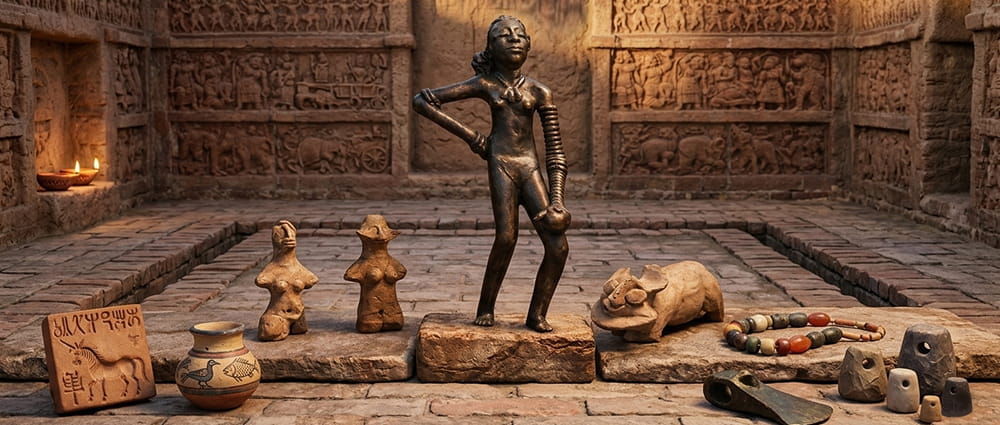
The sculpture depicts a young woman, nude, slender, long-limbed, standing in a natural, asymmetrical pose. Her weight rests slightly on her right leg. Her left arm hangs at her side, stacked high with 24 bangles reaching all the way up to her shoulder, while her right arm carries only 4 bangles and is bent at the elbow, resting on her hip. Around her neck, she wears a necklace with three pendants. Her hair is tied neatly at the nape of her neck in a spiral bun. Her head is tilted slightly backward, and her face carries an expression that has struck every observer the same way: one of complete, unshakeable confidence.
Locals in Sindh affectionately called her Sambara, a name born from admiration.
When the statue was excavated at Mohenjo Daro, the archaeologist who uncovered her in 1926 named her “The Dancing Girl” because her confident pose resembled the nautch performers once seen in royal courts.
Later, John Marshall, who oversaw the excavations as head of the Archaeological Survey of India, described her as a young girl standing boldly with one hand on her hip and her legs poised as if moving to music. The name “Dancing Girl” endured, while in Sindh, she remained lovingly known as Sambara.
Today, Sambara, the Dancing Girl of Mohenjo Daro, is displayed at the National Museum in New Delhi, India, where she remains one of the crown jewels of the Indus Valley Civilization gallery.
Key Facts About the Dancing Girl of Mohenjo Daro
Before we go deeper into her story, here is a quick reference to orient you:
- Official name: Dancing Girl (also known as the Dancing Girl of Mohenjo Daro).
- Date of creation: Approximately 2300–1750 BCE (some sources extend this to 2700–2100 BCE).
- Civilization: Indus Valley Civilization (also called the Harappan Civilization).
- Site of discovery: Mohenjo Daro, HR area (Hargreaves area), modern-day Sindh province, Pakistan.
- Year of discovery: 1926.
- Excavator: British archaeologist Ernest Mackay.
- Material: Bronze (copper-tin alloy).
- Dimensions: 10.5 cm, around 4.1 inches (height) × 5 cm (width) × 2.5 cm (depth).
- Technique: Lost-wax casting (cire perdue).
- Current location: National Museum, New Delhi, India.
- Accession number: D.K. (National Museum collection).
These facts alone tell a remarkable story, but the real story lies in the details.
The Civilization Behind the Statue: The Indus Valley Civilization
To truly understand the Dancing Girl of Mohenjo Daro, you need to understand the world she came from.
The Indus Valley Civilization, commonly known as the Harappan Civilization, was one of the world’s three earliest major urban civilizations, alongside ancient Mesopotamia and ancient Egypt. It flourished between approximately 3300 and 1300 BCE across a vast stretch of what is now Pakistan, northwest India, and parts of Afghanistan. At its peak, around 2500 BCE, this civilization was home to millions of people, with major cities that rivaled anything else that existed in the Bronze Age world.
Mohenjo Daro, where the Dancing Girl was found, was one of the largest and most sophisticated of these cities. Its very name, derived from Sindhi, translates roughly as “Mound of the Dead,” a name given by modern locals long before archaeologists understood what lay buried beneath the earth. The city was located on the western bank of the lower Indus River, in what is today the Sindh province of Pakistan. It flourished around 2500 BCE and was eventually abandoned around the 19th century BCE as the broader Indus civilization declined.
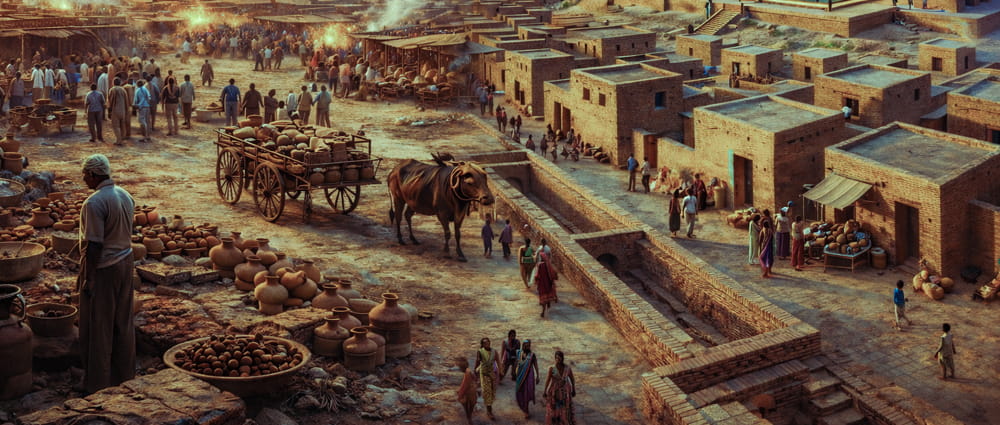
What made Mohenjo Daro extraordinary was its urban planning, something that genuinely shocked the archaeologists who excavated it. The city had carefully laid-out streets that intersected at right angles, a sophisticated drainage and sanitation system that was among the most advanced in the ancient world, multi-storied brick buildings, and monumental public structures such as the Great Bath and the Great Granary. The degree of organization and standardization on display, even the bricks were uniform in size, suggested a society with a powerful civic identity and a high level of administrative coordination.
In 1980, Mohenjo Daro was named a UNESCO World Heritage Site, making it one of the most important historical sites in the world.
It was in this city, this ancient, planned, literate, and sophisticated urban world that someone, more than four thousand years ago, created the Dancing Girl.
Discovery of the Bronze Dancing Girl Statue
The excavation of Mohenjo Daro began in earnest in the early 1920s. R. D. Banerji, an officer of the Archaeological Survey of India, first explored the site in 1919–1920. The formal announcement of the Indus Valley Civilization was made in 1924 by John Marshall, then Director-General of the Archaeological Survey of India, after excavations at both Mohenjo Daro and Harappa began revealing the true scale of what lay beneath the Pakistani earth.
It was during the winter excavation season of 1926 that British archaeologist Ernest Mackay made the discovery that would become one of archaeology’s most celebrated finds. Working in the HR (Hargreaves) area of Mohenjo Daro, specifically within a housing complex in what is cataloged as Block 7 Mackay, unearthed this small bronze figurine. She was assigned to the mature period of the Harappan Civilization (approximately 2600–1900 BCE), meaning she is not from the early or late phase of the culture, but from its absolute height.
The discovery was significant on multiple levels. This was not just another artifact; it was one of only two bronze figures found at Mohenjo Daro that showed more flexible, naturalistic features compared to the more formal poses of other sculptures at the site. She was, from the very first moment of her rediscovery, different. Mackay and Marshall recognized it immediately. John Marshall is known to have reacted with open surprise when he first saw her.
After excavation, the Dancing Girl of Mohenjo Daro and other finds were initially deposited at the Lahore Museum. However, they were later moved to the Archaeological Survey of India headquarters in New Delhi as part of planning for a new Central Imperial Museum in the British Raj’s new capital. Following the Partition of India in 1947, the Dancing Girl of Mohenjo Daro was allocated to India, and she has remained at the National Museum in New Delhi ever since, a decision that has remained a source of ongoing diplomatic tension, with Pakistani politicians and legal figures periodically calling for her return, arguing that she rightfully belongs to Pakistan, where she was found.
The Priest King: The Dancing Girl’s Silent Counterpart
If the Dancing Girl is the soul of Mohenjo Daro, the Priest King is its authority.
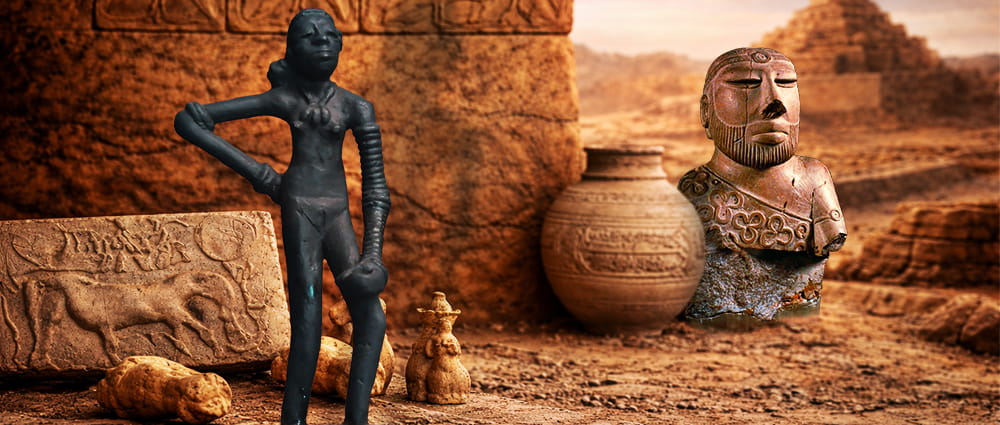
Discovered just a year later, in 1927, within the same ruins, the Priest King is a steatite bust standing 17.5 centimeters tall. Where the Dancing Girl is bronze, fluid, and alive with movement, he is carved from stone, formal, and deliberately imposing. His cloak bears a trefoil pattern once filled with red pigment, his eyes are half-closed in quiet authority, and every detail communicates hierarchy and restraint. One was forged through fire. The other was revealed through subtraction. Even their methods of making say something about what each figure represented.
She feels like a specific person. He feels like a position. Together, they are the two faces of a civilization that left no readable words behind: one intimate and human, the other composed and institutional.
Today, they are separated by a border. The Priest King remains at the National Museum of Pakistan in Karachi, while the Dancing Girl sits in New Delhi. Two objects found within the same ruins, within a year of each other, have been separated by a border that simply did not exist in their time. The argument for bringing them together is bigger than politics or sentiment. It is about understanding a civilization fully. The Dancing Girl Indus Valley Civilization belongs to neither nation nor both. To see them in the same room would be to see Mohenjo Daro whole again.
How Was the Dancing Girl Statue Made? The Lost-Wax Technique
One of the most striking things about the Dancing Girl of Mohenjo Daro is not just what she looks like, but how she was made. The sculpture was created using a technique called lost-wax casting, known in French as cire perdue, a process that was extraordinarily sophisticated for its time.
The process works like this: the artist first creates a detailed model of the figure in wax, capturing every nuance of the pose, the ornaments, and the proportions. This wax model is then covered with a layer of clay, with small holes left as passageways. When the clay mould is heated in an oven, the wax melts away and runs out through those holes, hence the name “lost-wax.” The empty clay cavity is then filled with molten bronze. Once the metal cools and hardens, the clay outer layer is chipped away, and the finished bronze sculpture is revealed. The craftsperson then applies the final detailing and finishing touches.
The fact that Indus Valley artisans had mastered this technique around 2500 BCE tells us something profound: these were not primitive people experimenting with fire and metal. They were sophisticated metallurgists with an expert command of copper-tin alloy composition and precise temperature control. Technical studies of the Dancing Girl’s bronze composition have confirmed that the Indus Valley developed bronze-working independently and achieved results comparable to and in some cases exceeding those of other Bronze Age cultures around the world.
What Does the Statue Reveal About the Indus Valley Civilization?
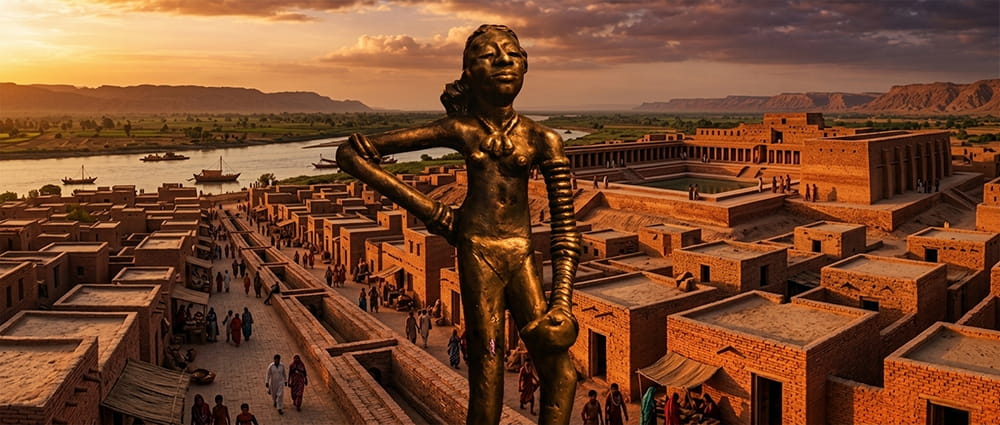
A civilization that leaves no translated written texts forces us to read its culture through its objects. The Indus Valley script remains unsolved to this day, which means that artifacts like the Dancing Girl of Mohenjo Daro carry an enormous interpretive burden; they must speak for an entire world that cannot speak for itself in words. And yet, she says a great deal.
Artistic sophistication: The Dancing Girl of Mohenjo Daro demonstrates that Indus Valley artisans had achieved a level of sculptural realism and expressive naturalism that is remarkable for the Bronze Age.
Her asymmetrical stance, what art historians call contrapposto, or the uneven distribution of weight, mirrors her uneven ornamentation, with 24 bangles on the left arm and only 4 on the right. This is not an accident. It is a deliberate artistic choice, one that creates visual rhythm and a sense of movement. The posture, the proportions, the tilt of the head, all of it reflects an artist who was not simply making a figure, but making a statement.
Metallurgical advancement: As discussed above, the lost-wax technique required real expertise. The existence of the Dancing Girl tells us that Mohenjo Daro had skilled metalworkers operating at a high professional level.
Social and cultural life: The Dancing Girl’s ornamentation, her bangles, and her necklace reflect a society in which jewelry carried deep social significance, whether as markers of status, rank, wealth, or cultural identity. Anthropologically, scholars have noted that the fashion of wearing bangles up the arm has parallels in tribal and cultural practices still found in parts of modern Rajasthan, suggesting long cultural continuities across thousands of years.
The statue of the Dancing Girl of Mohenjo Daro also suggests that art, performance, and personal adornment were valued aspects of life in Mohenjo Daro. Whether or not she was actually a dancer, the confident, expressive pose of the figure implies a culture in which the human body, particularly the female body, was depicted with dignity, naturalism, and artistic intention.
Religious or ritual significance. Some historians have speculated that the figure may have been a religious object, perhaps associated with a goddess or ritual practice. Historian Thakur Prasad Verma suggested she may represent the Hindu goddess Parvati, though most scholars have dismissed this as lacking sufficient evidence. What is clear is that the figure was not made for practical use. It was made to be seen, to carry meaning, to matter.
Why is the Dancing Girl of Mohenjo Daro Important?
She is just 10.5 centimeters tall. But her importance is immeasurable.
Before the excavation of Mohenjo Daro and the broader Indus Valley Civilization, relatively little was known about prehistoric India, particularly in the domain of metal sculpture. The Dancing Girl fundamentally reshaped that understanding. She established, beyond any doubt, that advanced sculptural and metallurgical traditions existed on the subcontinent thousands of years before they were previously thought to have emerged.
She is also important as a symbol of identity and belonging. Pakistani politicians have also called the Dancing Girl of Mohenjo Daro their Mona Lisa. Indian textbooks have featured her as a defining emblem of ancient Indian civilization. Scholars worldwide have written papers, chapters, and entire books about her. She has been analyzed through the lens of art history, anthropology, colonial theory, gender studies, and archaeology. The fact that a figurine no larger than a human hand has commanded nearly a century of scholarly attention is, in itself, a measure of her significance.
Mortimer Wheeler, one of the great archaeologists of the twentieth century, put it simply and memorably in 1973: “There’s nothing like her, I think, in the world.”
He was right. The Dancing Girl of Mohenjo Daro stands as she has always stood, chin up, weight on one hip, bangles catching an imagined light as one of the most extraordinary human creations that has ever survived the test of time.
She does not tell us everything about the Indus Valley Civilization. She cannot. But she tells us something essential: that the people who lived in this ancient city were artists, craftspeople, thinkers, and dreamers. That they looked at the world and decided to capture something true about it in bronze. And that truth has lasted more than four thousand years.
That is why she matters. And that is why we are still talking about her today.
Conclusion
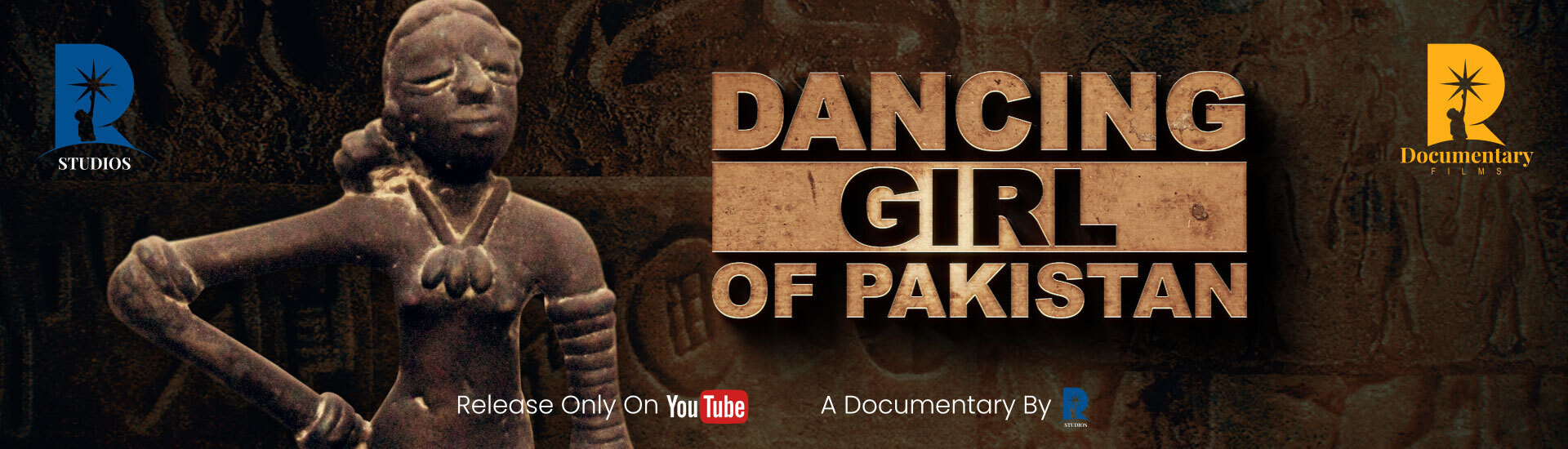
For those who want to go beyond the artifact itself and understand her story in a more visual and narrative form, Rava Documentary Films has also created a documentary exploring the Dancing Girl of Mohenjo Daro in depth. It brings together history, archaeology, and interpretation to help viewers reconnect with this extraordinary bronze figurine in a more immersive way. To know more about this beautiful statue, give it a look.
The Dancing Girl is currently on permanent display at the National Museum, New Delhi, India, in the Indus Valley Civilization gallery.